Medical notice. This page is for information only. It is not medical advice and does not replace a doctor. Severe abdominal pain needs urgent care — call 112 or go to hospital. See the medical disclaimer.
Necrotizing pancreatitis means inflammation of the pancreas is severe enough that some pancreatic tissue, nearby fat, or both, dies (necrosis). What causes necrotizing pancreatitis is usually the same as other severe acute pancreatitis — most often gallstones or heavy alcohol use. Infected necrosis is more dangerous than sterile necrosis. Survival figures vary widely; they are not a personal prognosis.
Watch: Osmosis / Elsevier — acute pancreatitis (medical education). Not medical advice.
What “necrosis” means here
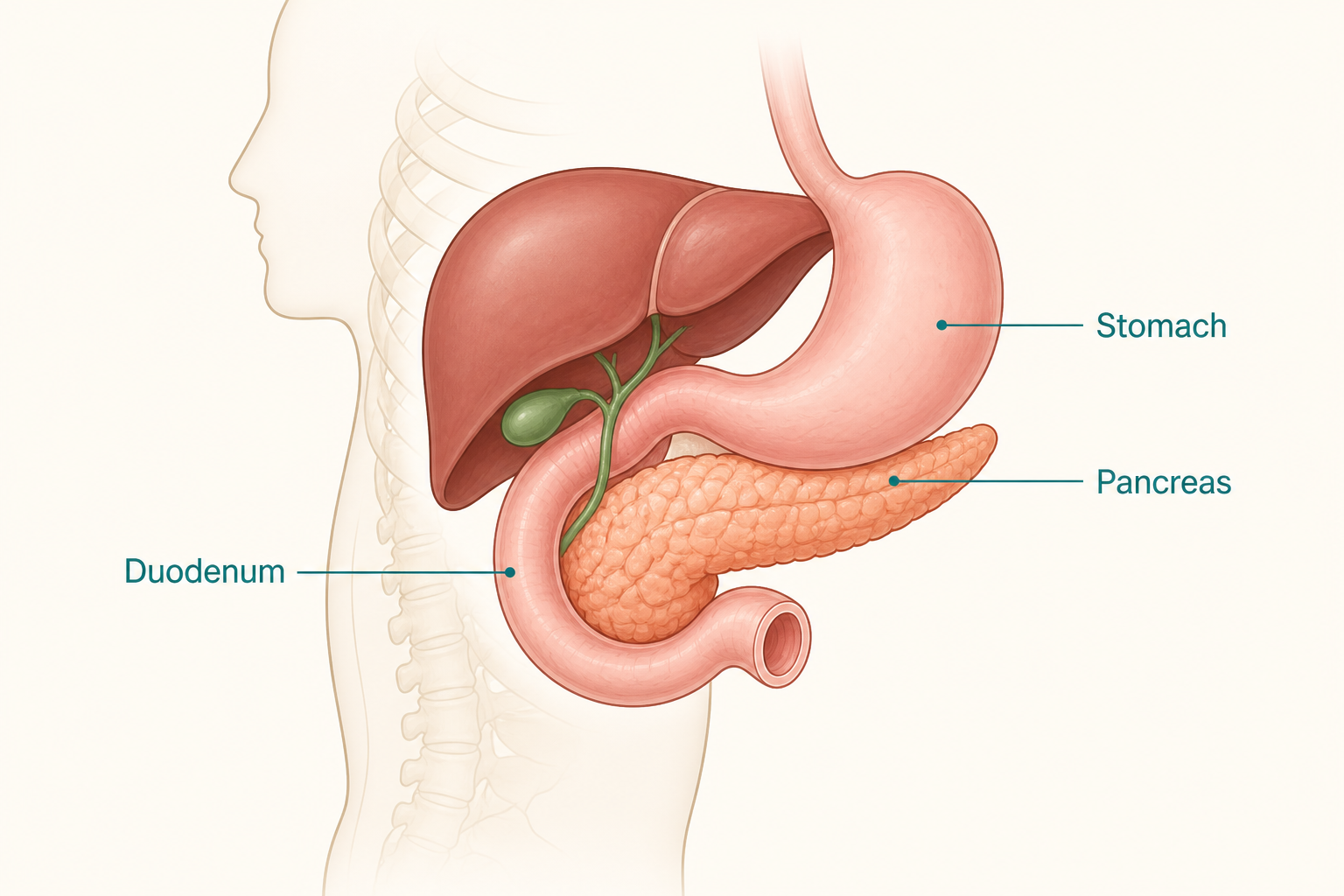
The pancreas makes digestive enzymes that are meant to switch on in the intestine. If they switch on too soon, they can injure the gland. When inflammation is intense enough to interrupt blood supply, tissue can die. That dead tissue is necrosis. (NIDDK; Mayo Clinic, dated 31 October 2025)
Banks PA, Bollen TL, Dervenis C, Vege SS (Mayo Clinic) and colleagues described necrotising (necrotizing) pancreatitis in the revised Atlanta classification as one of two morphologic types of acute pancreatitis. The other is interstitial oedematous disease, in which the gland is swollen but tissue is not dead. Necrosis can involve the pancreas itself, the tissues around it, or both. It is a type, not a numbered “stage”. See 4 stages of acute pancreatitis. (Banks et al., Gut, 2013; PubMed 23100216)
NHS lists pancreatic necrosis among complications of acute pancreatitis: some tissue dies, and infection can lead to sepsis. Most people with an acute attack never develop this picture. NHS Inform states that about 4 out of 5 cases improve quickly, while about 1 in 5 are severe. (NHS, last reviewed 11 March 2026; NHS Inform, last updated 24 August 2026)
NHS Inform explains infected pancreatic necrosis in plain language: high inflammation can interrupt the blood supply; dead tissue is then vulnerable to bacteria; untreated, the infection can spread in the blood and cause organ failure. They estimate it occurs in around 1 in 3 severe cases, usually 2 to 6 weeks after symptoms start. (NHS Inform)
What causes necrotizing pancreatitis
There is not a separate “necrotizing cause list”. The usual triggers of acute pancreatitis are the usual triggers here. Whether an attack stays mild or becomes necrotising depends on how severe the inflammation and organ failure become — that is not something a website can predict for one person.
The most common causes of acute pancreatitis are:
- Gallstones, which can block the opening of the pancreas
- Drinking a lot of alcohol
(NHS; NIDDK; ACG, patient topic originally by Banks PA, later updated)
NHS Inform puts gallstones at around half of cases and alcohol at about a quarter. Across Europe the mix shifts: gallstones dominate in much of southern Europe; alcohol is more often dominant in much of the east. (NHS Inform; Roberts et al., PubMed 28159463)
Less common causes, listed by NHS, NIDDK, Mayo Clinic Staff, and ACG, include injury (including during surgery), certain medicines, high blood triglycerides, high blood calcium (hypercalcaemia), procedures such as ERCP, some infections (NHS mentions mumps), pancreatic cancer (a different disease that can occasionally trigger pancreatitis), and no identified cause (idiopathic). (NHS; NIDDK; Mayo Clinic; ACG)
The IAP/APA guidelines, coordinated by Besselink MG, van Santvoort HC and Werner J, with Banks PA and Vege SS on the executive committee, recommend determining cause on admission using history (alcohol, medicines, known gallstones, recent ERCP), examination, blood tests (liver enzymes, calcium, triglycerides), and right-upper-quadrant ultrasound. (Working Group IAP/APA, Pancreatology, 2013)
NHS Inform notes that little is known about why some people develop severe disease; factors thought to raise that risk include age 70 or over, obesity (BMI 30 or above), drinking two or more alcoholic drinks a day, and smoking. That is not the same as a cause of necrosis itself. (NHS Inform)
Sterile versus infected necrosis
This distinction matters for outlook and treatment.
| Sterile necrosis | Infected necrosis | |
|---|---|---|
| Meaning | Dead tissue without proven infection | Bacteria in the necrotic collection |
| How it may be suspected | Imaging showing necrosis; the person may still be recovering | Persistent fever, rising inflammatory markers, gas in a collection on CT, or a sample that grows bacteria |
| Typical course | Many people can be managed without an operation | Often needs antibiotics and, if the person is deteriorating, drainage — usually delayed until the collection is walled-off |
| Mortality in published series | Lower than infected necrosis, but not zero — especially with organ failure | Higher; still varies widely |
IAP/APA state that clinical signs (persistent fever, rising inflammatory markers) and imaging (gas in collections) predict infected necrosis in most patients; routine needle aspiration is not indicated. The vast majority of sterile necrotising pancreatitis can be managed without catheter drainage or necrosectomy. A small proportion of stable patients with documented infection can be managed with antibiotics alone. (IAP/APA, 2013)
Werge M, Novovic S, Schmidt PN and Gluud LL pooled 71 studies (6,970 patients) in Pancreatology (2016). 801 of 2,842 patients with infected necrosis died (28%); 537 of 4,128 with sterile necrosis died (13%). The odds of death were more than twice as high with infection (odds ratio 2.57; 95% CI 2.00–3.31). Mortality was 35.2% with infected necrosis and organ failure, 19.8% with sterile necrosis and organ failure, and 1.4% with infected necrosis without organ failure. Those are pooled research figures, not a forecast for one person, and they mix older and newer treatment eras. (Werge et al., Pancreatology, 2016; PubMed 27449605)
Dellinger EP, Forsmark CE, Layer P, et al. used infected necrosis plus persistent organ failure as the critical category in the determinant-based classification — the sickest group in that system, not an Atlanta “stage 4”. (Dellinger et al., Ann Surg, 2012; PubMed 22735715)
Hospital treatment (overview — not a protocol)
There is no specific medicine that treats pancreatitis itself. Care is supportive and then directed at the cause and at complications. (Mayo Clinic — Diagnosis & treatment; NIDDK)
Typical hospital measures include intravenous fluids, pain relief, and nutrition (by mouth when it is safe, or by feeding tube). IAP/APA recommend against routine intravenous antibiotic prophylaxis to prevent infection. Antibiotics are used when infection is suspected or confirmed. (IAP/APA, 2013; NHS)
If gallstones caused the attack, ERCP may be used when there is cholangitis or a blocked bile duct; gallbladder removal is often planned once it is safe. NIDDK notes that operating to remove the gallbladder within a few days of admission can lower complications in appropriate mild gallstone cases; if pancreatitis is severe, surgery may be delayed while complications are treated. (IAP/APA, 2013; NIDDK)
For infected necrosis, IAP/APA recommend a step-up approach: image-guided percutaneous drainage or endoscopic drainage first, then necrosectomy only if needed. Invasive intervention should be delayed, where possible, until at least 4 weeks, so the collection can become walled-off. The 2025 IAP revision keeps that step-up approach (strong recommendation). These documents are written for clinicians, not for self-treatment. (IAP/APA, 2013; IAP 2025)
Mayo Clinic Staff note that pancreatic infections are serious and may need procedures to remove infected tissue. ACG’s patient topic (originally Banks PA) likewise says surgery may be needed if there is a severe infection called necrosis. (Mayo Clinic; ACG)
This site does not list drug doses, antibiotic names as a protocol, or “what to ask the surgeon to do”. Those decisions belong to the hospital team.
Survival rate — published ranges, not a personal figure
The necrotizing pancreatitis survival rate is better than older textbooks sometimes implied, and it still depends on organ failure, infection, age, other illnesses, and how care is organised. Published numbers vary widely. They should not be read as “your” percentage. For the wider picture of acute versus chronic outlook, see Pancreatitis life expectancy and Statistics.
Verified figures used on this page:
- Most acute pancreatitis is not necrotising; about 4 of 5 attacks improve quickly. (NHS Inform)
- IAP/APA: mortality up to 30% in severe acute pancreatitis. (IAP/APA, 2013)
- Banks et al.: persistent organ failure in the first few days — published mortality as great as 36–50%; infected necrosis plus persistent organ failure described as extremely high mortality. (Banks et al., Gut, 2013)
- Werge et al.: pooled 28% mortality in infected necrosis versus 13% in sterile necrosis; 35.2% when infection and organ failure occur together; 1.4% if infected necrosis has no organ failure. (Werge et al., 2016)
- NHS Inform: even with high standards of care, the risk of dying from organ failure in infected pancreatic necrosis is estimated at around 1 in 5; untreated, they describe it as almost always fatal. (NHS Inform)
We do not average those numbers. They come from different methods and years.
After hospital, NHS and NIDDK both stress that another attack is possible. Stopping alcohol (even if alcohol was not the cause), stopping smoking, a lower-fat eating pattern, and finishing the plan for gallstones or high triglycerides all reduce that risk. Continuing to drink after acute pancreatitis can lead to more attacks and to chronic pancreatitis. (NHS; NIDDK)
Named sources are listed on Sources.
FAQ
What causes necrotizing pancreatitis?
The same things that cause other severe acute attacks — most often gallstones or heavy alcohol use, plus less common triggers such as high triglycerides, some medicines, ERCP, trauma, or no found cause. Necrosis is how severe inflammation can damage tissue, not a separate cause list. (NHS; NIDDK)
Is necrotizing pancreatitis the same as severe pancreatitis?
Not exactly. Atlanta severity is about persistent organ failure. Necrotising disease is a morphologic type. They often overlap, but a collection of dead tissue and organ failure are classified separately. (Banks et al., Gut, 2013)
What is the survival rate?
It varies widely. Pooled research has reported about 13% mortality with sterile necrosis and 28% with infected necrosis, and much higher figures when organ failure is also present. NHS Inform estimates around 1 in 5 for death from organ failure in infected necrosis even with good care. None of these is a personal forecast. (Werge et al., 2016; NHS Inform)
Do all people with necrosis need surgery?
No. IAP/APA say most sterile necrosis is managed without intervention. When infection needs a procedure, the usual first step is drainage, often delayed until about four weeks, not immediate open surgery. (IAP/APA, 2013)
Are antibiotics given to everyone?
No. Routine prophylactic intravenous antibiotics are not recommended. Antibiotics are used for suspected or proven infection. (IAP/APA, 2013)
When should I call 112?
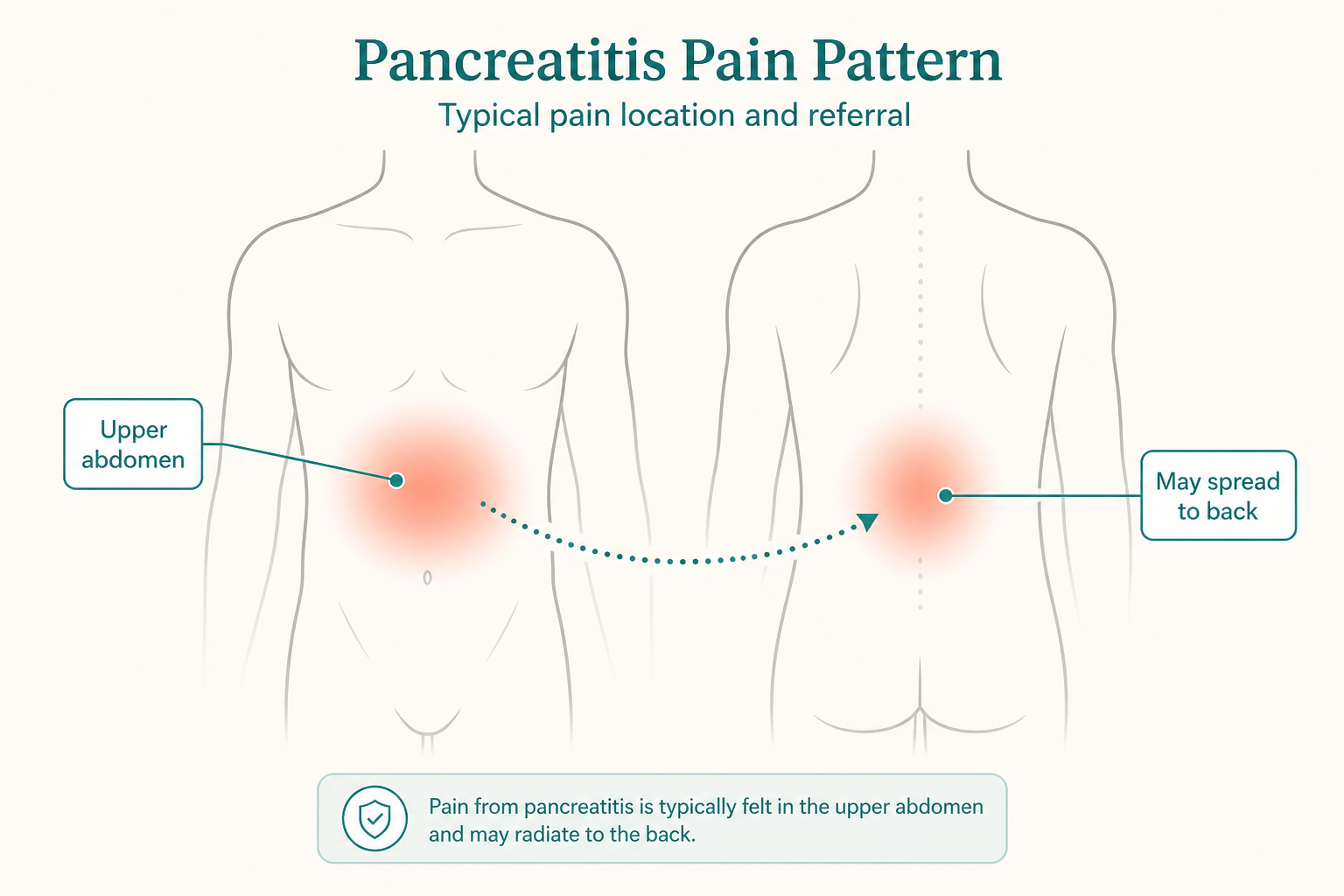
Sudden severe tummy pain, especially spreading to the back, with vomiting, fever, a fast heartbeat, or difficulty breathing. Do not wait to “see if it is necrosis”. (NHS)
See also: 4 stages of acute pancreatitis · Acute pancreatitis · Pancreatitis life expectancy · Statistics · What is pancreatitis
Last editorial check: 29 August 2026. Not medically reviewed by a clinician.
Infected necrosis mortality ranges (Werge et al.; NHS Inform) also appear in the warning-signs article Can you die from pancreatitis? Necrosis/infection status maps to the sixth character of K85.xx — see Acute pancreatitis ICD-10.