Medical notice. This page is for information only. It is not medical advice and does not replace a doctor. Severe abdominal pain needs urgent care — call 112 or go to hospital. See the medical disclaimer.
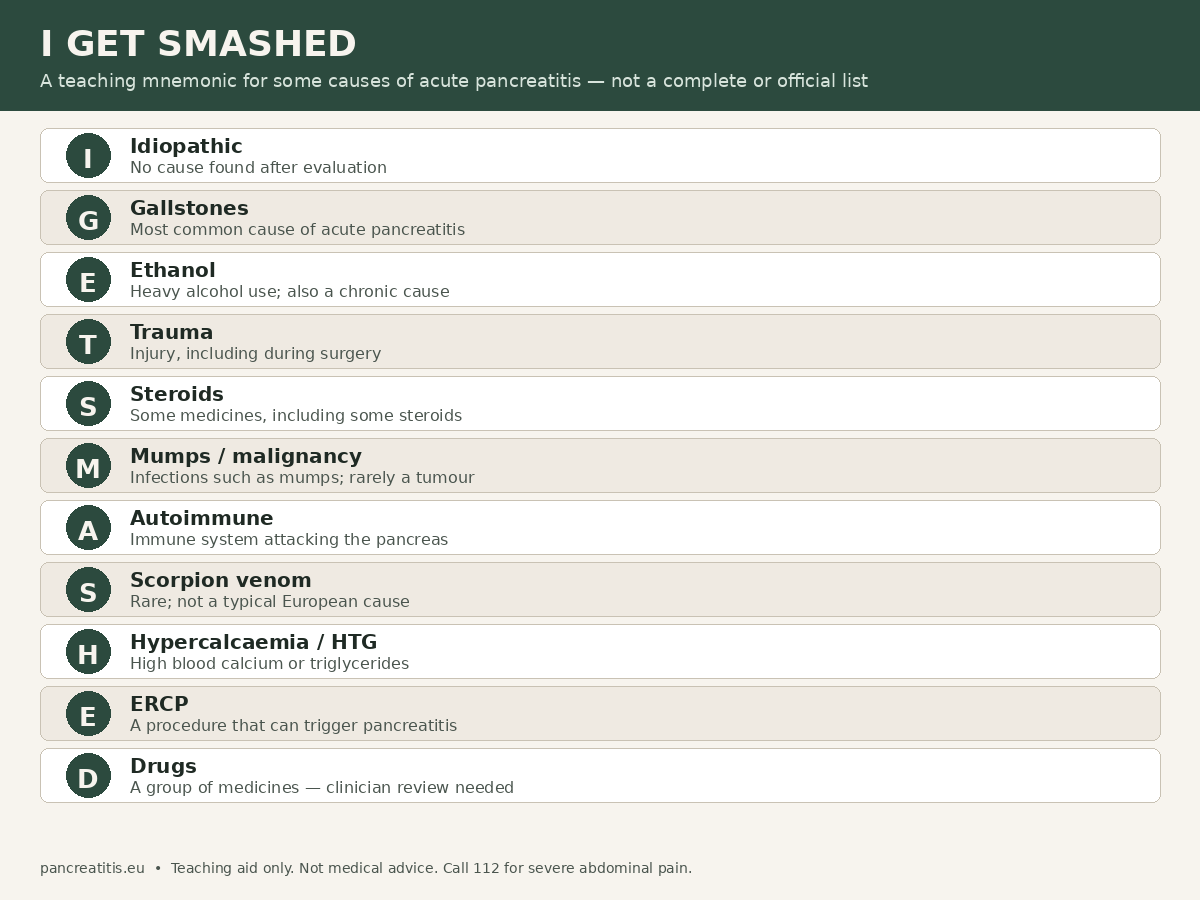
I GET SMASHED is a teaching mnemonic for causes of acute pancreatitis, not an official or complete list. Gallstones and alcohol (ethanol) cause most attacks. The other letters are less common reminders for students. It does not replace a hospital work-up. Sudden severe tummy pain needs 112, not a mnemonic.
Watch: Osmosis / Elsevier — acute pancreatitis (medical education). Not medical advice.
What the mnemonic is — and is not
Medical students use I GET SMASHED to remember possible causes of acute pancreatitis. It is a memory aid, not a guideline and not a ranking of how often each cause occurs. Banks PA, Bollen TL, Dervenis C, Vege SS (Mayo Clinic) and colleagues, in the revised Atlanta classification, described how clinicians diagnose acute pancreatitis (two of three: typical pain; lipase or amylase at least three times the upper limit of normal; characteristic imaging). Atlanta does not use this mnemonic. (Banks et al., Gut, 2013; PubMed 23100216)
NHS, NIDDK and Mayo Clinic Staff all put gallstones and heavy alcohol use first. Everything else on the list is less common. Some real causes — smoking, inherited conditions such as cystic fibrosis, pancreas divisum — do not get their own letter. For the patient-facing list, see Symptoms and causes and What is pancreatitis. (NHS, last reviewed 11 March 2026; NIDDK; Mayo Clinic, dated 31 October 2025)
The IAP/APA guidelines, coordinated by Besselink MG, van Santvoort HC and Werner J, with Banks PA and Vege SS on the executive committee, ask clinicians to look for cause on admission: history (alcohol, medicines, known gallstones, recent ERCP), examination, blood tests (liver enzymes, calcium, triglycerides), and right-upper-quadrant ultrasound. That is a work-up, not a mnemonic recitation. (Working Group IAP/APA, Pancreatology, 2013)
Letter by letter
| Letter | Stands for | Plain meaning | How common, in sourced pages |
|---|---|---|---|
| I | Idiopathic | No cause found after tests | Mayo Clinic Staff and NIDDK: sometimes a cause is never found. ACG: unknown in nearly a third of chronic cases after extensive evaluation — that figure is for chronic disease, not a rate for every acute attack. |
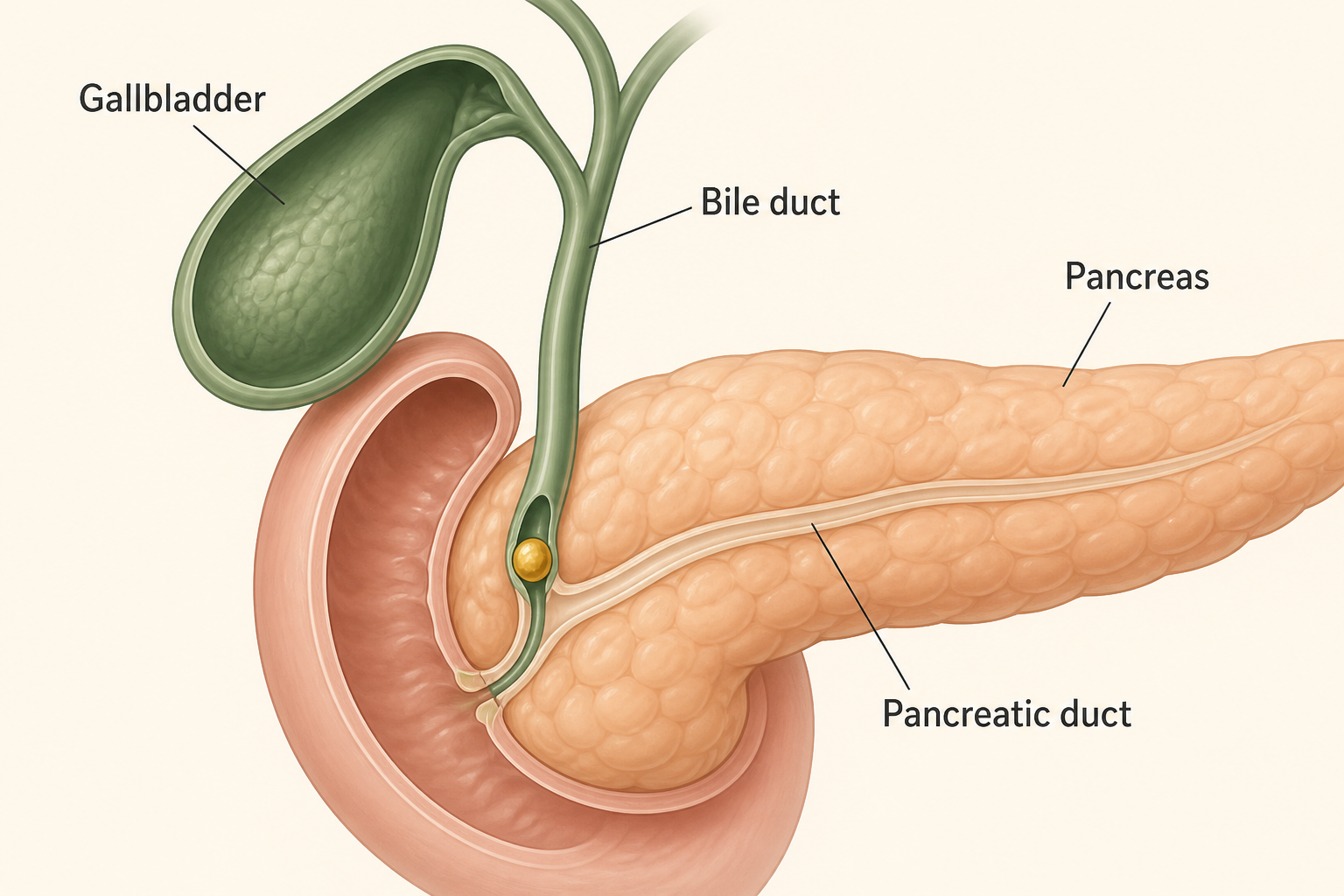
| G | Gallstones | Stones can block the opening of the pancreas (gallstone pancreatitis) | NHS and NIDDK: the most common cause of acute disease. NHS Inform: around half of cases. NICE: around 50%. |
| E | Ethanol | Heavy alcohol use | NHS: the other leading cause. NHS Inform: about a quarter. NICE: around 25%. Dominant in much of eastern Europe (Roberts et al.). |
| T | Trauma | Injury to the pancreas, including during surgery | NHS and Mayo Clinic Staff list injury, including surgery and endoscopy. Uncommon compared with stones and alcohol. |
| S | Steroids | Certain steroid medicines | NHS lists certain steroids among medicines that can trigger pancreatitis. Not every steroid course. Do not stop a prescribed medicine from this page. |
| M | Mumps / malignancy | Viral infection such as mumps; rarely a cancer blocking a duct | NHS lists mumps and pancreatic cancer among less common causes. NHS Inform also mentions measles. Cancer is a different disease that can occasionally trigger pancreatitis. |
| A | Autoimmune | The immune system attacking the pancreas | Mayo Clinic Staff list an autoimmune condition among causes of chronic disease. NHS lists lupus among less common acute causes, and the immune system attacking the gland among chronic causes. |
| S | Scorpion | Sting of certain scorpions | A rare teaching example, not a European cause. Bartholomew C. described acute pancreatitis after stings of Tityus trinitatis in Trinidad (1970). |
| H | Hypercalcaemia / hypertriglyceridaemia | High blood calcium; high blood fats (triglycerides) | NHS lists hypercalcaemia. Mayo Clinic Staff, NIDDK and ACG list high triglycerides and high calcium. This page does not invent a laboratory cut-off. |
| E | ERCP | Endoscopic retrograde cholangiopancreatography | NIDDK lists ERCP done for another condition as a cause. Mayo Clinic Staff note that ERCP may trigger acute pancreatitis. IAP/APA include recent ERCP in the admission history. |
| D | Drugs | Certain other medicines | NHS: some heart and epilepsy medicines. NHS Inform: some antibiotics, weight-loss and chemotherapy medicines. Mayo Clinic Staff: “certain medicines”. Culprit drugs belong to the clinical team, not a website list. |
Sources for the table: NHS; NHS Inform, last updated 24 August 2026; NIDDK; Mayo Clinic; ACG; NICE NG104; Roberts et al., PubMed 28159463; Bartholomew, Br Med J, 1970 (PubMed 5443968).
The two letters that actually matter for most people
Gallstones and ethanol are not two equal items on a twelve-item list. They are the usual answers.
NIDDK: the most common cause of acute pancreatitis is gallstones. Stones passing through or lodging in a bile or pancreatic duct inflame the pancreas. NHS: the most common causes are gallstones and drinking a lot of alcohol. NICE (UK) puts the split at around 50% gallstones, 25% alcohol, and 25% other factors. Across Europe, Roberts SE and colleagues found gallstones dominant in much of the south (including Croatia) and alcohol more often dominant in much of the east. (NIDDK; NHS; NICE NG104; Roberts et al.)
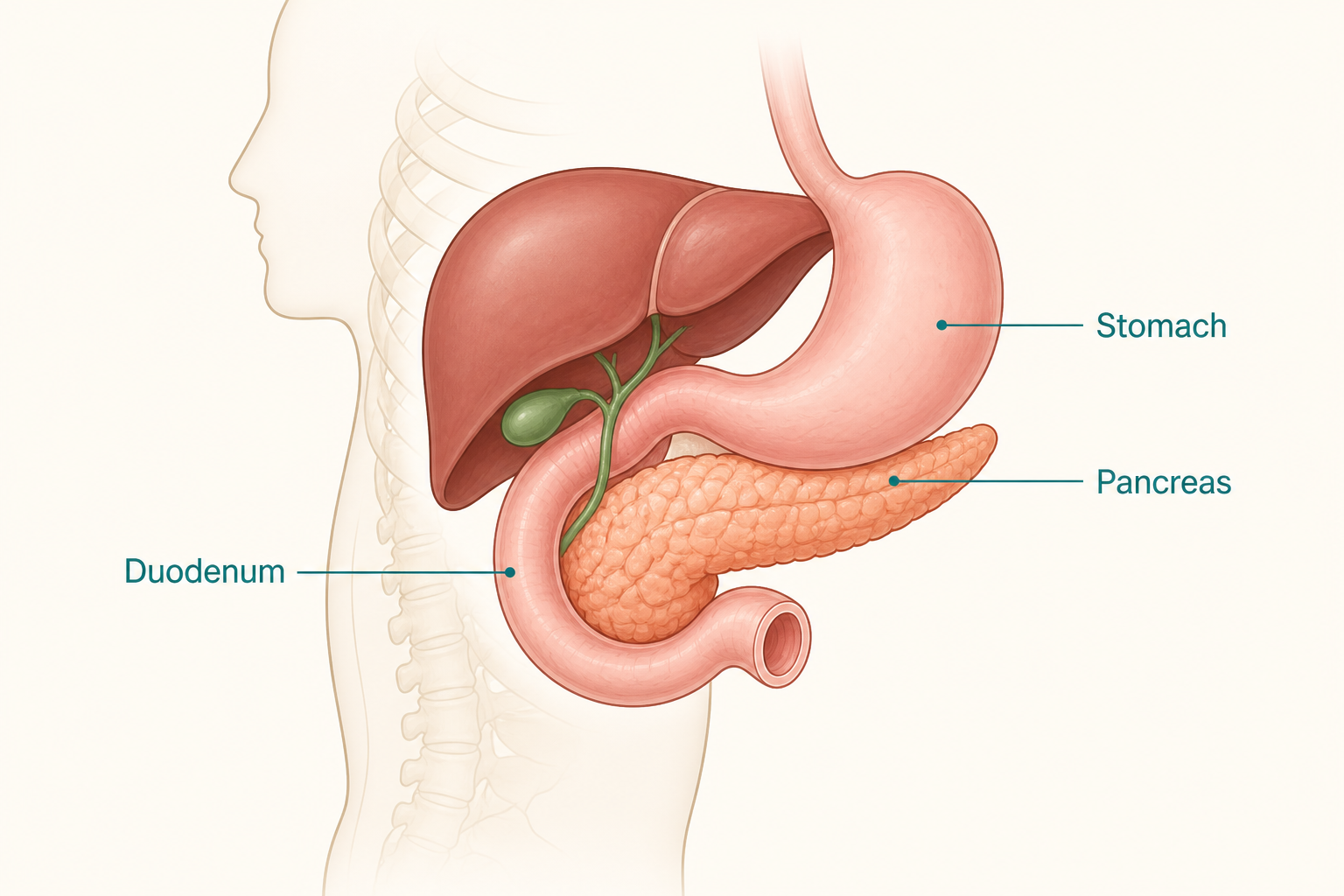
If gallstones caused the attack, hospital care may later include ERCP when a bile duct is blocked, and gallbladder removal when it is safe. If alcohol caused it, stopping drinking is the prevention. Continuing to drink after acute pancreatitis can lead to more attacks and to chronic disease. (NIDDK — Treatment; NHS; Mayo Clinic — Diagnosis & treatment)
Letters that confuse people
Scorpion is in the mnemonic because Bartholomew documented pancreatitis after Tityus trinitatis stings in Trinidad. Over two months, 30 people were admitted after stings; acute pancreatitis developed in 24. All recovered in that series. It is a real, geographically limited cause — not something to look for in a European emergency department unless the history actually includes a sting. (Bartholomew, 1970)
Steroids and drugs are real but uncommon. NHS names certain steroids and some heart and epilepsy medicines; NHS Inform adds some antibiotics, weight-loss and chemotherapy medicines. Mayo Clinic Staff advise talking with a clinician about medicines rather than stopping them from a list. ACG’s patient topic (originally Banks PA) includes “drug induced pancreatitis — avoid offending medication” among prevention points, which is a clinical decision. (NHS; NHS Inform; Mayo Clinic; ACG)
ERCP is both a cause of pancreatitis and a treatment used when gallstones are stuck in the bile duct. Mayo Clinic Staff note that ERCP may trigger acute pancreatitis, so it is not for everyone. IAP/APA reserve urgent ERCP for cholangitis or persistent bile-duct obstruction, not as a routine test. (Mayo Clinic; IAP/APA, 2013)
What the mnemonic misses
Smoking does not have a letter. Mayo Clinic Staff note that people who smoke cigarettes are about three times more likely to develop pancreatitis than people who do not, and that quitting can decrease risk. ACG lists smoking among causes of acute disease and among the common causes of chronic disease. (Mayo Clinic; ACG)
Inherited conditions (including the gene that causes cystic fibrosis) and pancreas divisum appear on NIDDK and NHS chronic pages. They are real; they simply do not fit the rhyme. (NIDDK; NHS — Chronic pancreatitis)
Severe inflammation can progress to necrotizing pancreatitis — dead tissue in or around the gland. That is a type of acute disease, not a thirteenth letter. (Banks et al., Gut, 2013)
Named papers and pages are listed on Sources.
FAQ
Is I GET SMASHED an official list of pancreatitis causes?
No. It is a teaching mnemonic. NHS, NIDDK, Mayo Clinic and IAP/APA do not use it as a classification. Gallstones and alcohol still account for most acute cases. (NHS; NICE NG104)
What does each letter in I GET SMASHED stand for?
Idiopathic, Gallstones, Ethanol, Trauma, Steroids, Mumps/malignancy, Autoimmune, Scorpion, Hypercalcaemia/hypertriglyceridaemia, ERCP, Drugs. See the table above. It is not complete.
Do I need every letter checked after one attack?
No. IAP/APA describe a focused admission work-up. Which tests you need is a hospital decision. (IAP/APA, 2013)
Can scorpion sting cause pancreatitis in Europe?
The classic papers describe Tityus trinitatis in Trinidad. It is a rare teaching example. European cases are not the reason the letter exists. (Bartholomew, 1970)
Should I stop my steroid or epilepsy medicine?
No — not from this page. NHS lists certain medicines as uncommon triggers. Changing a prescription is a clinician’s job. (NHS; Mayo Clinic)
When should I call 112?
Sudden severe tummy pain, especially spreading to the back, with vomiting, fever, a fast heartbeat, or difficulty breathing. A mnemonic is not first aid. (NHS)
See also: Symptoms and causes · Acute pancreatitis · What is pancreatitis · Necrotizing pancreatitis · Sources
Last editorial check: 29 August 2026. Not medically reviewed by a clinician.