Medical notice. This page is for information only. It is not medical advice and does not replace a doctor. Severe abdominal pain needs urgent care — call 112 or go to hospital. See the medical disclaimer.
People search for “4 stages of acute pancreatitis”, but clinicians do not use a four-stage Atlanta scale. The revised Atlanta classification (2012) uses three severity grades — mild, moderately severe, and severe — plus two morphologic types and an early versus late phase. Banks PA, Bollen TL, Dervenis C, et al. described that system in Gut (2013).
Watch: Osmosis / Elsevier — acute pancreatitis (medical education). Not medical advice.
What people mean by “4 stages”
The phrase is common online. It is not how international consensus classifies the illness. Three ideas get mixed together:
- Severity grades — the revised Atlanta system has three grades, not four. (Banks et al., Gut, 2013; PubMed 23100216)
- A four-category system — Dellinger EP, Forsmark CE, Layer P, et al. described a determinant-based classification the same year: mild, moderate, severe, and critical. Those are categories of severity, not a sequence every patient walks through. (Dellinger et al., Ann Surg, 2012; PubMed 22735715)
- Four types of fluid collection — Atlanta names four local collections. They are imaging findings, not four steps of one disease. (Banks et al., Gut, 2013)
This page puts those systems side by side so the search query is answered without inventing a fake “stage 1–4” Atlanta ladder. For the basic picture, see What is pancreatitis and Acute pancreatitis.
Atlanta criteria: what clinicians actually use
The 2012 revision, published in Gut in 2013, is a classification for adults, not a treatment guideline. It asks four practical questions:
- Is it acute pancreatitis? Two of three features must be present.
- What type is it on imaging? Interstitial oedematous, or necrotising (necrotizing) pancreatitis.
- How severe is it? Mild, moderately severe, or severe.
- When in the course is this? Early phase or late phase.
The original 1992 Atlanta meeting used a simpler mild-versus-severe split. The revision added the middle grade and tightened the language for collections and necrosis. (Banks et al., Gut, 2013)
The IAP/APA guidelines, coordinated by Besselink MG, van Santvoort HC and Werner J, with Banks PA and Vege SS (Mayo Clinic) on the executive committee, use the same Atlanta language for diagnosis and severity. (Working Group IAP/APA, Pancreatology, 2013)
Diagnosis (Atlanta “2 of 3”): abdominal pain consistent with the disease; serum lipase or amylase at least three times the upper limit of normal; characteristic findings on imaging. Two of those three make the diagnosis. Imaging is often not needed at the door. When a CT is used to look for necrosis, IAP/APA advise waiting at least 72–96 hours after symptoms start. NHS diagnoses with blood tests and sometimes a CT, and treats in hospital straight away. (Banks et al.; IAP/APA, 2013; NHS, last reviewed 11 March 2026)
Comparison table
| What you may hear | What it actually is | Sequential “stages”? |
|---|---|---|
| “4 stages of acute pancreatitis” | Informal search phrase; not an Atlanta scale | No official four-step Atlanta ladder |
| Revised Atlanta severity | Three grades: mild / moderately severe / severe | No — the grade depends on how long organ failure lasts |
| Revised Atlanta types | Interstitial oedematous or necrotising | Two morphologic types |
| Revised Atlanta phases | Early and late | Time course of one illness |
| Four collections | APFC, ANC, pancreatic pseudocyst, walled-off necrosis | Types of collection; not everyone develops them |
| Determinant-based classification | Four categories: mild, moderate, severe, critical | Categories of severity, not a pathway |
Sources: Banks et al., Gut, 2013; Dellinger et al., 2012.
The three Atlanta severity grades
Mild is the most common form: no organ failure and no local or systemic complications. Banks and colleagues wrote that it usually resolves in the first week. (Banks et al., Gut, 2013)
NHS Inform (NHS 24) states that about 4 out of 5 cases improve quickly without serious further problems, while about 1 in 5 are severe and can lead to life-threatening complications such as multiple organ failure. Most people leave hospital in 5 to 10 days. (NHS Inform, last updated 24 August 2026; NHS)
Moderately severe means transient organ failure (less than 48 hours), and/or local complications, and/or a flare of a pre-existing illness. It can still mean a longer stay. (Banks et al., Gut, 2013)
Severe means persistent organ failure lasting more than 48 hours (one organ or several). Banks and colleagues reported that people who develop persistent organ failure in the first few days are at increased risk of death, with published mortality as great as 36–50% in that group. Infected necrosis on top of persistent organ failure is described as carrying an extremely high mortality. Those figures are not a personal prognosis. (Banks et al., Gut, 2013)
IAP/APA note a reported annual incidence of 13–45 per 100,000, and mortality up to 30% in severe disease. Severity is reassessed; Atlanta suggests review at 24 hours, 48 hours, and 7 days. (IAP/APA, 2013; Banks et al.)
Two types, two phases — not four stages
Interstitial oedematous pancreatitis: the gland is swollen; tissue is inflamed but not dead. Necrotising pancreatitis: some pancreatic tissue, nearby fat, or both, has died. Necrosis may stay sterile or become infected. Necrotising disease is a morphologic type, not “stage 4”. See Necrotizing pancreatitis. (Banks et al., Gut, 2013)
The early phase is usually over by the end of the first week (it can stretch into the second). The question is whether organ failure appears and whether it lasts beyond 48 hours. The late phase is about collections, necrosis that may become infected, and procedures if the person is not recovering. IAP/APA recommend delaying invasive treatment of infected necrosis, where possible, until about 4 weeks. (Banks et al.; IAP/APA, 2013; IAP 2025, DOI 10.1016/j.pan.2025.04.020)
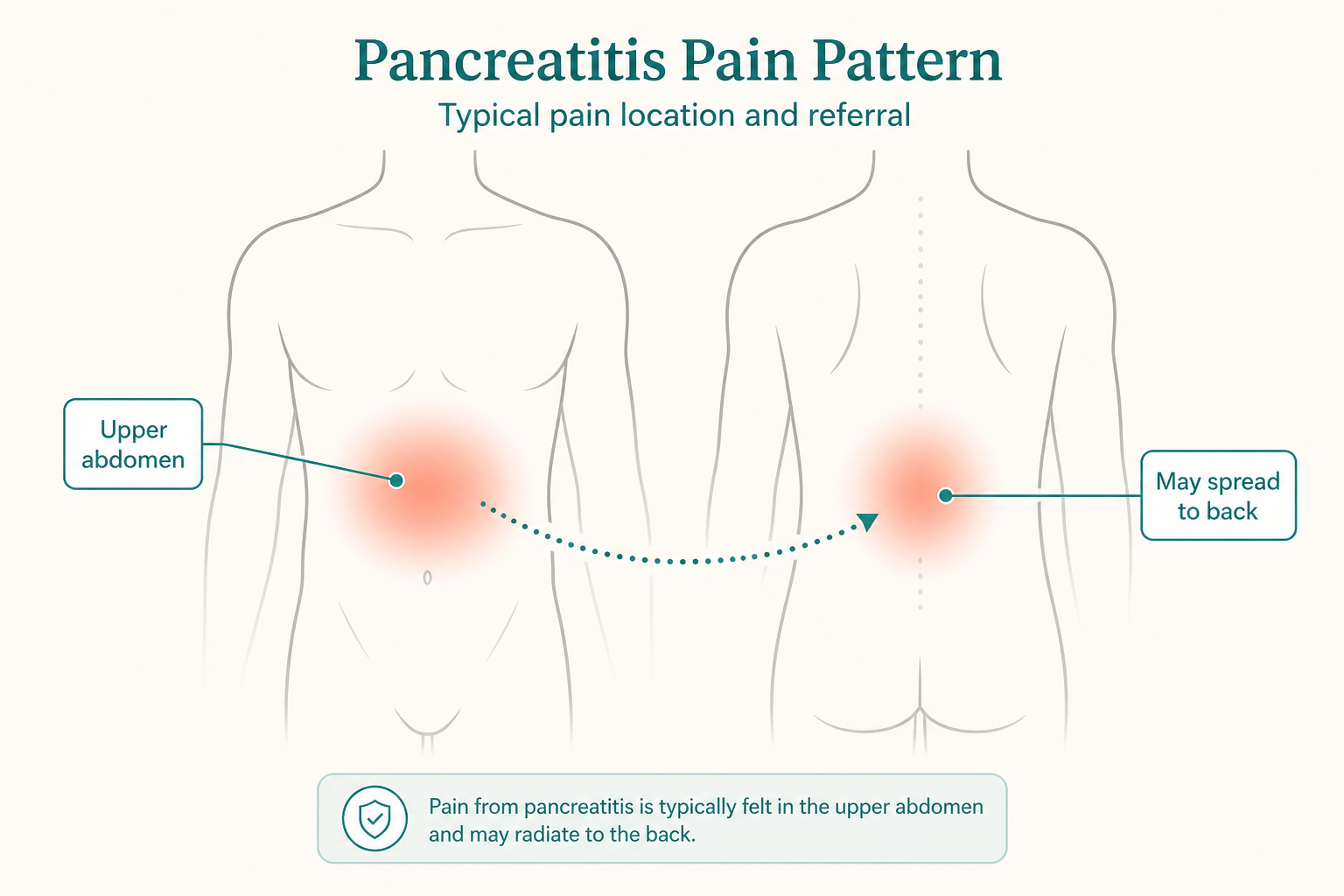
Typical symptoms are sudden upper-abdominal pain (often to the back), nausea, vomiting, fever, and a fast heartbeat. That is an emergency, not a numbered stage. Call 112. (NHS; NIDDK)
Four collections — types, not a ladder
These are the four local collections Atlanta names. They are not a pathway every patient follows.
| Collection | Typical setting | Usual timing | Plain meaning |
|---|---|---|---|
| Acute peripancreatic fluid collection (APFC) | Interstitial (oedematous) pancreatitis | First 4 weeks | Fluid around the pancreas without solid necrosis |
| Acute necrotic collection (ANC) | Necrotising pancreatitis | First 4 weeks | Fluid and dead tissue, not yet walled-off |
| Pancreatic pseudocyst | After interstitial disease | After 4 weeks | Encapsulated fluid, little or no necrosis |
| Walled-off necrosis (WON) | After necrotising disease | After 4 weeks | Encapsulated collection that still contains necrosis |
Any of these can be sterile or infected. Older words such as “pancreatic abscess” and “phlegmon” were dropped in 2012. NHS lists cysts and pancreatic necrosis among complications; most people still recover fully. (Banks et al., Gut, 2013; NHS)
The determinant-based critical category is infected necrosis and persistent organ failure together — the sickest group in that system, not an Atlanta “stage 4”. (Dellinger et al., 2012)
This is not a cancer staging system. Pancreatitis is inflammation. Mayo Clinic Staff (page dated 31 October 2025) list pancreatic cancer among possible causes of pancreatitis and note higher cancer risk in long-standing chronic inflammation — that is a different disease. Hospital care is supportive: fluids, pain relief, nutrition, and treatment of the cause. There is no specific medicine that switches pancreatitis off. (Mayo Clinic; Mayo Clinic — Diagnosis & treatment; NIDDK)
Named papers and pages are listed on Sources.
FAQ
Does Atlanta classify acute pancreatitis in four stages?
No. It uses three severity grades, two morphologic types, and early versus late phases. (Banks et al., Gut, 2013)
Why do people say “4 stages”?
They may mean the four collection types, or the four-category determinant-based system (mild, moderate, severe, critical). Neither is a numbered Atlanta stage list. (Banks et al.; Dellinger et al.)
What are the Atlanta diagnostic criteria of pancreatitis?
Two of three: typical pain; lipase or amylase at least three times the upper limit of normal; characteristic imaging. (Banks et al., Gut, 2013)
When does mild disease become severe?
Severe means persistent organ failure lasting more than 48 hours. Mild disease has neither organ failure nor local or systemic complications. (Banks et al., Gut, 2013)
Is necrotising pancreatitis a late stage?
No. It is a type of acute pancreatitis on imaging, not a numbered stage. See Necrotizing pancreatitis.
Can I stage myself at home from this table?
No. Classification is done in hospital. Sudden severe tummy pain is a reason to call 112, not to match yourself to a chart. (NHS)
See also: What is pancreatitis · Acute pancreatitis · Necrotizing pancreatitis · Symptoms and causes · Sources
Last editorial check: 29 August 2026. Not medically reviewed by a clinician.