Medical notice. This page is for information only. It is not medical advice and does not replace a doctor. Severe abdominal pain needs urgent care — call 112 or go to hospital. See the medical disclaimer.
Most people recover from acute pancreatitis. A minority have severe or necrotizing pancreatitis that can be fatal. Chronic pancreatitis is not cured; alcohol and smoking make the outlook worse. Published survival figures vary by country, cause and era — they are not a personal life expectancy.
Watch: Osmosis / Elsevier — chronic pancreatitis (medical education). Not medical advice.
How to read any number on this page
“Life expectancy” in search results often mixes three different questions: the chance of dying during one hospital admission; how long people with chronic disease live after diagnosis; and modelled population death rates. Those are not interchangeable. Definitions, hospital coding, and treatment eras differ. Unverified percentages are omitted. See also Statistics. Named papers are listed on Sources.
Löhr JM, Dominguez-Munoz E, Rosendahl J, et al., writing the HaPanEU guidelines for United European Gastroenterology, used a median survival of about 20 years after chronic pancreatitis to estimate prevalence. That is a planning figure, not a promise that any one person has twenty years. (Löhr et al., United European Gastroenterology Journal, 2017; PubMed 28344786)
Acute pancreatitis — most people get better
NIDDK: most people with acute pancreatitis get better, and the illness goes away in several days with treatment. Some have a severe form that needs a long hospital stay. The condition can be life-threatening. (NIDDK)
NHS: most people start to get better within a week and can leave hospital in 5 to 10 days. Most recover fully. Acute pancreatitis can still be life-threatening; people are monitored in hospital for complications. (NHS, last reviewed 11 March 2026)
NHS Inform: about 4 out of 5 cases improve quickly and do not cause serious further problems; about 1 in 5 are severe and can lead to life-threatening complications such as multiple organ failure. (NHS Inform, last updated 24 August 2026)
NICE (UK guideline context) states that the overall mortality rate in acute pancreatitis is approximately 5%. In the more severe group — about 25% of cases in that summary — people often need critical care, and the mortality rate is 25%. Those are UK context figures, not a personal risk. (NICE NG104)
The IAP/APA guidelines, coordinated by Besselink MG, van Santvoort HC and Werner J, with Banks PA and Vege SS (Mayo Clinic) on the executive committee, note mortality up to 30% in severe acute pancreatitis. (Working Group IAP/APA, Pancreatology, 2013)
Banks PA, Bollen TL, Dervenis C, Vege SS and colleagues wrote that people who develop persistent organ failure in the first few days are at increased risk of death, with published mortality as great as 36–50% in that group. Infected necrosis on top of persistent organ failure is described as carrying an extremely high mortality. Mild Atlanta disease, by contrast, usually resolves in the first week. (Banks et al., Gut, 2013; PubMed 23100216)
Severe and necrotizing disease
Necrotising (necrotizing) pancreatitis is a type of acute disease — some pancreatic or nearby tissue has died — not a separate illness. It may stay sterile or become infected. Details: Necrotizing pancreatitis.
Werge M, Novovic S, Schmidt PN and Gluud LL pooled 71 studies (6,970 patients). Mortality was 13% with sterile necrosis and 28% with infected necrosis; 35.2% when infection and organ failure occurred together; 1.4% if infected necrosis had no organ failure. NHS Inform estimates around 1 in 5 for death from organ failure in infected pancreatic necrosis even with high standards of care; untreated, they describe it as almost always fatal. We do not average those numbers. (Werge et al., Pancreatology, 2016; PubMed 27449605; NHS Inform)
Chronic pancreatitis — no cure, many years for most
NHS: chronic pancreatitis is a long-term condition. There is currently no cure. The condition can affect how long you live, although this is different for everybody. Most people live with it for many years. Damage usually gets worse over time and cannot be reversed — but not drinking alcohol and not smoking can help slow it and reduce other problems. (NHS, last reviewed 20 October 2025)
NHS Inform: people who do not smoke and avoid drinking alcohol tend to experience less pain and live longer than those who continue to drink and smoke after a diagnosis. If you continue to drink, they say you are more likely to die from a complication of chronic pancreatitis. (NHS Inform — Chronic pancreatitis, last updated 18 March 2026)
NIDDK: when people with chronic pancreatitis caused by alcohol continue to drink, the condition is more likely to lead to severe complications and even death. Smoking with pancreatitis may raise pancreatic cancer risk. (NIDDK — Treatment)
Lowenfels AB, Maisonneuve P, Cavallini G, Ammann RW, Lankisch PG, Andersen JR, DiMagno EP (Mayo Clinic) and colleagues followed 2,015 people with chronic pancreatitis at seven centres in six countries. Overall survival was 70% at 10 years (95% CI 68–73%) and 45% at 20 years (95% CI 41–49%) — significantly less than the background population. There were 559 deaths versus 157.4 expected (standardised mortality ratio 3.6; 95% CI 3.3–3.9). Smoking, continued drinking, older age at diagnosis, and cirrhosis increased the risk of death in that cohort. Those figures are from 1994; care and smoking rates have changed. They are not a personal forecast. (Lowenfels et al., Am J Gastroenterol, 1994; Mayo Clinic research record)
HaPanEU’s median survival of about 20 years is consistent with using a long course to estimate prevalence (around 120 per 100,000 if incidence is 5–10 per 100,000). It is not an NHS “you have 20 years” statement. (Löhr et al., 2017)
NHS Inform estimates that for every 100 people with chronic pancreatitis, only 1 or 2 will develop pancreatic cancer — a higher risk than the general population, still a minority of patients. NHS also lists a higher pancreatic cancer risk. That is not the same as a life-expectancy number. (NHS Inform; NHS)
Comparison table
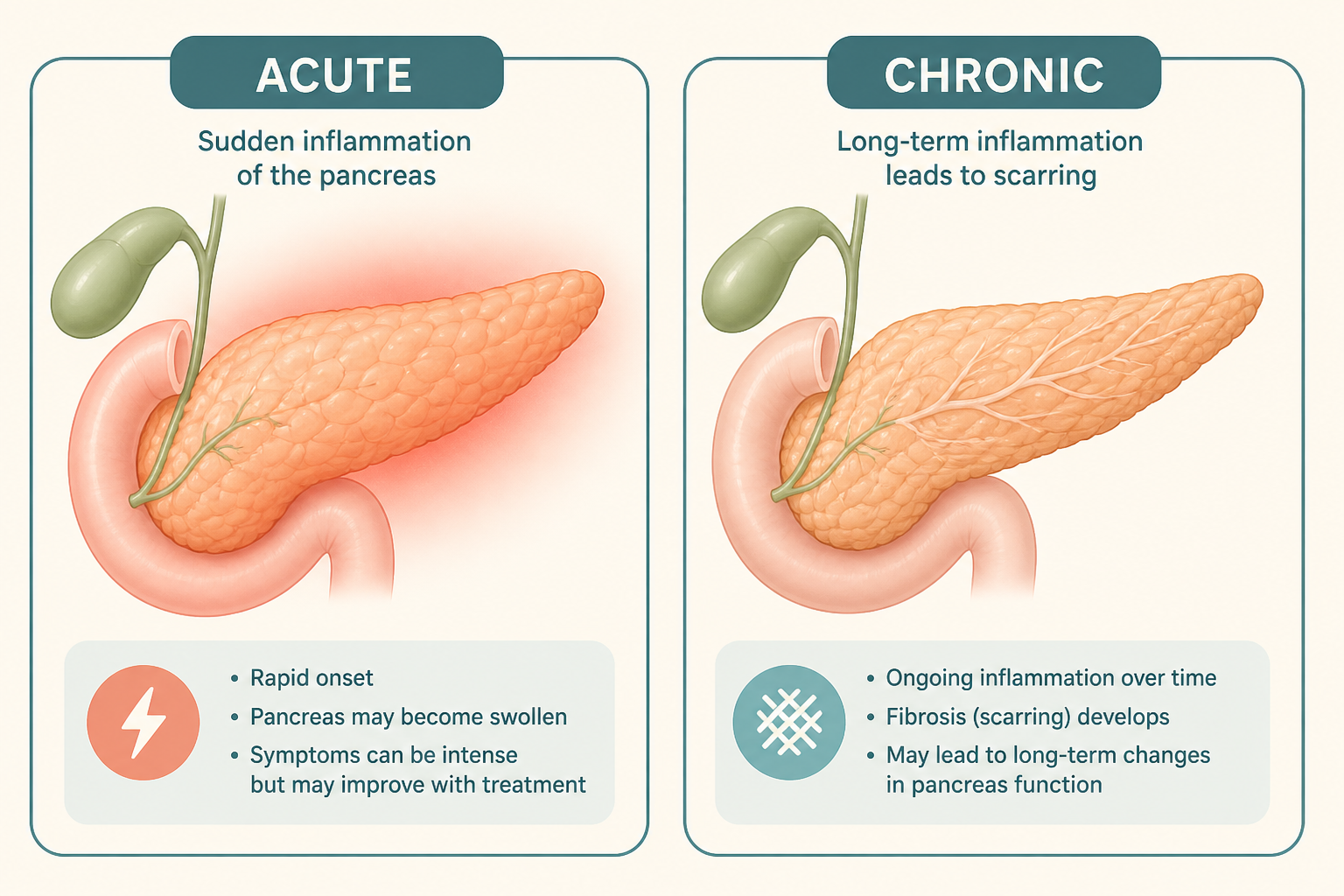
| Acute pancreatitis | Chronic pancreatitis | |
|---|---|---|
| Usual course | Most recover; NHS: often 5–10 days in hospital | No cure; NHS: most people live with it for many years |
| Published death risk in one spell | NICE: overall about 5%; about 25% in the severe subgroup they describe | Not a single-admission figure — a long-term condition |
| Severe / necrosis | IAP/APA: mortality up to 30% in severe disease; Banks et al.: up to 36–50% with persistent organ failure | Repeated acute attacks can scar the gland permanently |
| What worsens outlook | Persistent organ failure; infected necrosis; continuing to drink or smoke | Continuing alcohol (especially if alcohol was the cause); smoking; cirrhosis in older series |
| What clinicians emphasise | Hospital care, treat the cause, prevent the next attack | Stop alcohol, stop smoking, enzymes, pain and diabetes care |
Sources: NHS acute; NHS chronic; NICE NG104; IAP/APA, 2013; Banks et al., 2013; NIDDK.
What we are not claiming
- We do not turn NICE’s 5% or Werge’s 28% into “your” percentage.
- We do not give a European “average life expectancy in years” for pancreatitis. HaPanEU’s 20-year median and Lowenfels’ 10- and 20-year survival come from different methods and decades.
- We omit unverified blog figures and any number we could not trace to NHS, NICE, NIDDK, Mayo Clinic, HaPanEU, Atlanta, IAP/APA, or a named paper above.
- Population modelled deaths (GBD) on the statistics page are not individual life expectancy.
Ask the team looking after you what applies in your case.
FAQ
Does pancreatitis shorten life expectancy?
A mild acute attack that resolves often does not. Severe acute disease, especially with persistent organ failure or infected necrosis, can be fatal. Chronic pancreatitis can affect how long you live; NHS says most people still live with it for many years. (NHS; NICE NG104)
What is the survival rate of acute pancreatitis?
NICE’s UK context figure is about 5% overall mortality, and about 25% in severe cases as they define them. IAP/APA cite mortality up to 30% in severe disease. Most people still recover. (NICE NG104; IAP/APA, 2013; NHS)
How long do people live with chronic pancreatitis?
There is no single number. HaPanEU used a median survival of about 20 years to estimate prevalence. Lowenfels et al. reported 70% survival at 10 years and 45% at 20 years in a 1994 multicentre cohort. NHS: most people live with it for many years. (Löhr et al., 2017; Lowenfels et al., 1994; NHS)
Does stopping alcohol and smoking change the outlook?
Yes, according to NHS, NHS Inform and NIDDK. Continuing to drink after alcohol-related chronic disease makes severe complications and death more likely. People who stop smoking and alcohol tend to have less pain and live longer in NHS Inform’s wording. (NHS; NHS Inform; NIDDK)
Is necrotizing pancreatitis always fatal?
No. Pooled research has reported much lower mortality when organ failure is absent, and higher mortality when infection and organ failure occur together. See Necrotizing pancreatitis. (Werge et al., 2016)
Can I calculate my own life expectancy from this table?
No. Classification and prognosis are done in hospital. Sudden severe tummy pain is a reason to call 112. (NHS)
See also: Necrotizing pancreatitis · Chronic pancreatitis · Acute pancreatitis · Statistics · Sources
Last editorial check: 29 August 2026. Not medically reviewed by a clinician.
Emergency warning signs (NHS 999/A&E criteria) and a side-by-side table of published death-risk figures are on Can you die from pancreatitis? That page does not invent a “die in your sleep” statistic.