Medical notice. This page is for information only. It is not medical advice and does not replace a doctor. Severe abdominal pain needs urgent care — call 112 or go to hospital. See the medical disclaimer.
Pancreatitis is inflammation of the pancreas. Inflammation is the body’s response to injury. In the pancreas it causes swelling, pain, and changes in how the gland works. (Mayo Clinic; NIDDK)
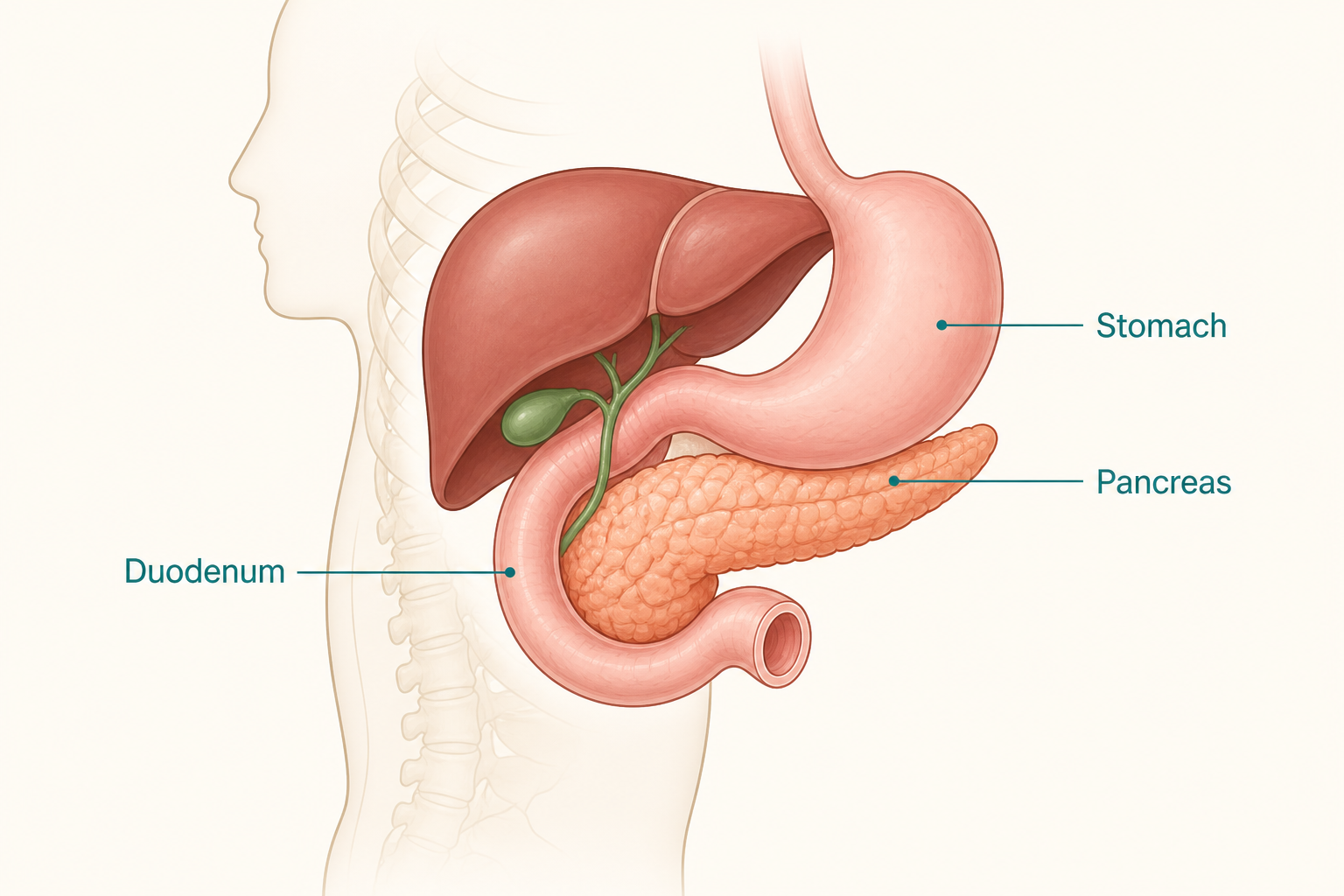
Watch: The role and anatomy of the pancreas (animation, National Pancreas Foundation). Not medical advice.
The pancreas is a large gland behind the stomach, close to the duodenum (the first part of the small intestine). It has two main functions:
- to make digestive enzymes that help break down food in the intestine
- to make insulin and other hormones that regulate blood sugar
Those enzymes are stored in an inactive form. They are meant to switch on only after they reach the small intestine. If they switch on too soon, they can start digesting the pancreas itself. That injury triggers inflammation. (Mayo Clinic; NIDDK)
Pancreatitis can be acute or chronic. Either form is serious and can lead to complications. (NIDDK)
Acute pancreatitis
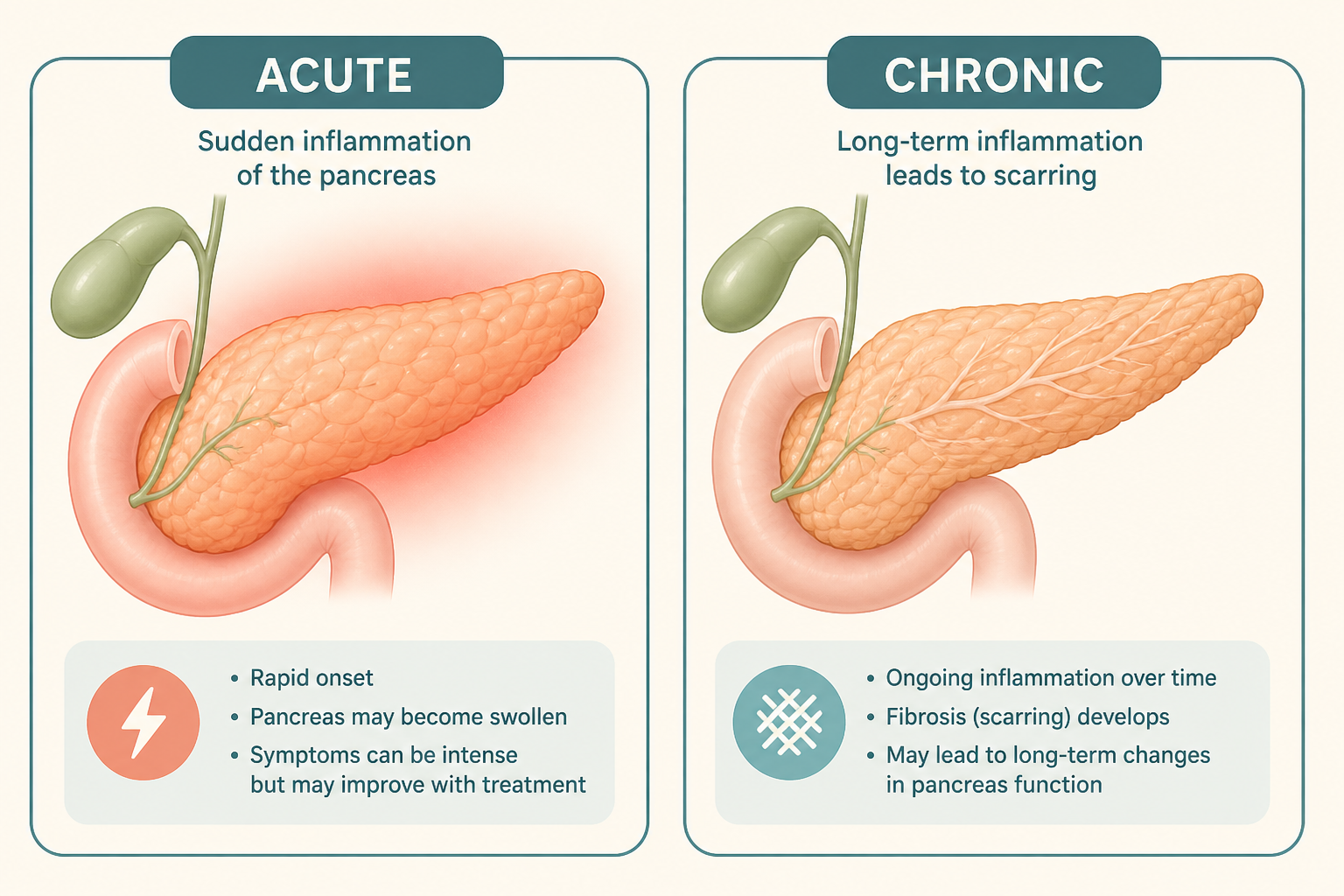
Acute pancreatitis starts suddenly and is a short-term condition. The pancreas becomes swollen and painful. It needs urgent treatment in hospital. (NHS; NIDDK)
Most people get better, and the episode settles in several days with treatment. Some people have a more severe form that needs a long hospital stay. Most recover fully, but some develop complications, and the illness can be life-threatening. Repeated attacks may lead to chronic pancreatitis. (NIDDK; NHS)
Read: Acute pancreatitis
Chronic pancreatitis
Chronic pancreatitis is a long-lasting condition. The pancreas is inflamed, scarred, and often painful. It does not heal or improve; damage can get worse over time and become permanent. There is currently no cure, but treatment can help with pain, digestion, diabetes, and other problems. (NHS; NIDDK; Mayo Clinic)
The European HaPanEU guidelines (United European Gastroenterology) describe chronic pancreatitis as a continuing inflammatory disorder in which pancreatic tissue is replaced by fibrosis, so that exocrine and/or endocrine function can fail. Long-term complications include diabetes and a higher risk of pancreatic cancer. (Löhr et al., HaPanEU, United European Gastroenterology Journal, 2017)
Read: Chronic pancreatitis
How the two forms compare
For emergency warning signs and published mortality ranges (not a personal prognosis), see Can you die from pancreatitis? Coders and clinicians looking up K85/K86 can start at Pancreatitis ICD-10.
| Acute | Chronic | |
|---|---|---|
| Timing | Sudden; usually days to weeks | Months to years; progressive |
| Damage | Often reversible after a mild attack | Permanent scarring (fibrosis) |
| Pain | Severe upper-abdominal pain, often to the back | Constant or coming and going; may ease when leaning forward |
| Digestion | Eating may be paused then restarted | Enzymes may be too low; oily stools, weight loss |
| Blood sugar | Can be disturbed in severe illness | Diabetes can develop (including type 3c) |
| Outlook | Most recover; a minority have severe or fatal disease | No cure; stopping alcohol and smoking can slow further damage |
The revised Atlanta classification uses three severity grades, not a four-stage ladder — see 4 stages of acute pancreatitis. When tissue dies, see necrotizing pancreatitis. Outlook: pancreatitis life expectancy.
Sources: NIDDK; NHS acute; NHS chronic; Mayo Clinic; ACG.
Who is more likely to get it
Risk is higher in:
- men than in women
- people with a family history of pancreatitis or gallstones
- people with obesity, diabetes, heavy alcohol use, or who smoke
- people with a personal or family history of gallstones
Mayo Clinic notes that people who smoke cigarettes are about three times more likely to develop pancreatitis than people who do not, and that people who drink more than four alcoholic drinks a day are at increased risk. A body-mass index of 30 or higher also raises risk. In US data, Black people have a higher risk than White people. (Mayo Clinic; NIDDK)
Complications (overview)
Both forms can lead to narrowing or blockage of a bile or pancreatic duct, leakage from the pancreatic duct, pseudocysts (fluid collections), damage to the pancreas, and, in severe illness, heart, lung, or kidney failure — and death. (NIDDK)
Acute complications include infection, pancreatic necrosis (death of tissue), cysts, breathing problems, and kidney failure. (Mayo Clinic; NHS)
Chronic complications include ongoing pain, maldigestion, malnutrition, diabetes, bone thinning (osteopenia/osteoporosis) and fractures, and a higher chance of pancreatic cancer — especially in people who have both diabetes and pancreatitis. (NIDDK; NHS)
Diagnosis, in outline
Doctors combine your story and examination with tests. Blood tests often look at amylase and lipase (enzymes made by the pancreas). Imaging may include ultrasound (especially for gallstones), CT, MRI/MRCP, or endoscopic ultrasound. Stool tests can look for fat that is not being absorbed. Chronic pancreatitis can be hard to diagnose early. (NIDDK — Diagnosis; Mayo Clinic — Diagnosis & treatment; ACG)
International consensus (the 2012 revision of the Atlanta classification) diagnoses acute pancreatitis in adults when two of these three are present: pain typical of the disease; serum lipase or amylase at least three times the upper limit of normal; and characteristic findings on imaging. (Banks et al., Gut, 2013)
What you can do that is evidence-based
You cannot always prevent pancreatitis. Steps that help include:
- treating or preventing gallstones (healthy weight and diet; gallbladder surgery if your team advises it after a gallstone attack)
- not drinking alcohol if you have had pancreatitis — even a mild episode, and even if alcohol was not the cause
- stopping smoking
- a balanced, lower-fat eating pattern, staying hydrated, and reviewing medicines with a clinician if a drug is suspected
(Mayo Clinic; NIDDK — Treatment; NHS)
This site does not recommend supplements or over-the-counter “pancreas support” products.
Next: Acute pancreatitis · Chronic pancreatitis · Symptoms and causes
Last editorial check: 29 August 2026.